Free p&P to the UK & NI

This is the year I start
After many years of avoiding oil paints, I'm diving in to explore this new medium over 2026.
4/21/20267 min read
I have to admit: I've always been kind of "turned off" by oil paints. There are several reasons for this:
First, when I was about fourteen I was gifted a job lot of mostly unused tubes of paint by a family friend, including a big tube of black paint (I always run out of white and black paint quicker than most colours). But when I started working with the black, it didn't mix well with the other paints and it clogged up my brush. More alarmingly, try as I might, I couldn't get it clean with my usual jar of water.
It was only when I then looked more closely at the tube and found that in a bag full of gouache and acrylic paints, somehow this person had gifted me just a single tube of oil paint. I was a bit peeved to learn on consulting one of my art books that oil paints require thinners and mediums to dilute them, which for my teenage pocket seemed an exorbitant extra expense on top of the costs of the paints themselves.
Then, throughout secondary school, we were all taught how to paint on stretched paper using acrylic paints and this was the case from Year 7 (entry level) right up to year 12 (A level). I assume this was partly about fairness (students' techniques may be judged more fairly by examiners if they are all using the same materials), but also some safety considerations probably had a part to play too (even a smaller cohort of A-level students working with solvents in a school studio space would undoubtedly produce a lot of unpleasant fumes and there are some people who, let's face it, simply shouldn't be left alone with flammable liquids...) As a result, I never received any formal training in using oil paints or painting on stretched canvas (I wouldn't even touch a canvas painting until I was in my early thirties).
Then, finally, there's the snob-factor. There are a lot of folks out there who are terribly snooty about oil paints; proclaiming haughtily that they are a far more elevated fine art form than acrylics, which they dismiss as "plasticky" or entry-level materials for kids and hobbyists - not a medium for "serious" painters.
Now, any kind of snobbery is a big turn-off for me, and this is of a kind which really rubs me up the wrong way. It so often comes from people who are not artists themselves, and even when it comes from those that are they tend to think themselves to be of a much higher calibre than they really are (IMHO - I suspect they think that using a "superior" medium will make their art better by association?)
So, because of all these factors, I have avoided oil paints for my whole creative life: the expense, the learning curve, and all the nasty associations surrounding oils just made me feel like oil paints weren't for the likes of me.
But in 2025, after 12 years of not touching a canvas or my acrylic paints, I suddenly felt the urge to produce paintings on canvas again. The result was my 'Kingsmead' collection of acrylic meadowscapes, which used up old tubes of paint (saving the materials from landfill) to create a series of contemplations on urban fringe habitats. Whilst I was getting back into painting after so many years (and with no formal training in canvas printing) I started devouring YouTube videos by other artists, sharing their techniques, inspirations and business advice. As I went further down this rabbit hole, I encountered many artists producing excellent work in oils and I learned from them that water-soluble oils were a thing. If only someone had told me this back when I was fourteen! I also learned that, while oil paintings do take up to a year to cure, they should be touch-dry much sooner and can be finished earlier using a retouch or exhibition varnish.
Gradually, seeing the amazing work others were creating and the differences in finish (not quality, I hasten to add) between acrylics and oils, I felt a growing urge to just get over my misgivings and give them a go. What was the worst that could happen? I was still troubled especially by the initial financial outlay, but I resolved to overcome all the negative voices in my head and just make a start somewhere.
I softened the financial cost slightly by investing in a set of Daler-Rowney Georgian range of water-soluble oil paints. I settled on these largely because I already used Daler-Rowney's acrylics and other products and have known them since my teens to be a reliable brand I can generally depend on for quality materials at a reasonable price point for me (I am not sponsored by D-R in any way; I just really like their products) Buying a set instantly gave me a limited range of colours in smaller tubes, so I could enjoy experimenting without overthinking it and for a smaller financial outlay.
The white spirit we already had a home for DIY jobs would make do for a solvent in the first instance and I already had a couple of canvasses lined up and ready to be prepped.
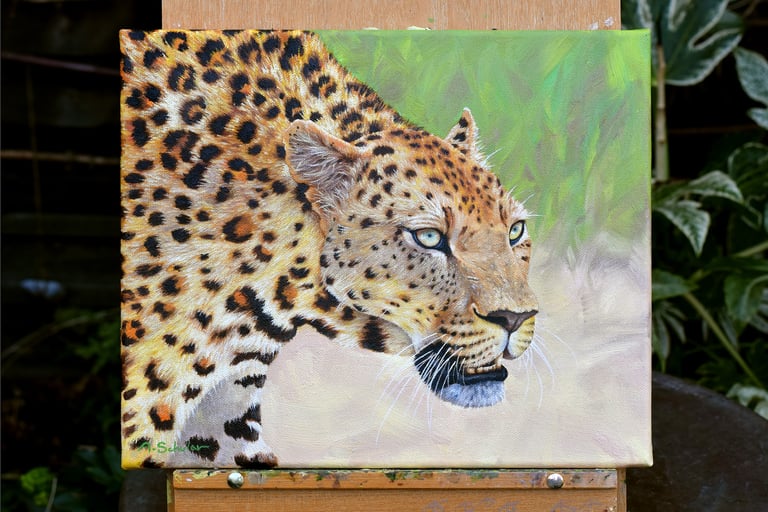
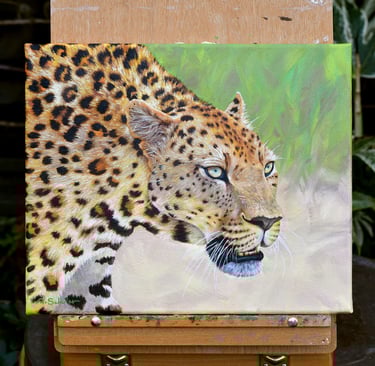
But what to paint? After painting plants for a whole year, I was dying to get back into wildlife art and big cats were a no-brainer for me. I scoured the internet for inspiration and stumbled across a Flickr account from a photographer who makes all his images open for use under a creative commons licence. I was struck by one image of an African leopard, which had real intensity and was complex enough a subject to be interesting to paint without being too adventurous for my first go at a new medium (and, again, not having painted an animal on canvas for about 12 years!)
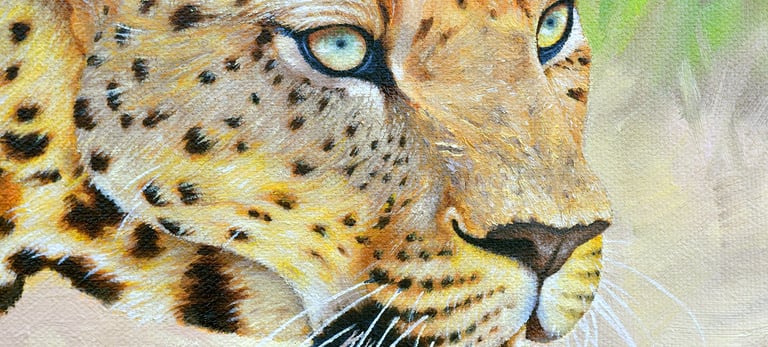
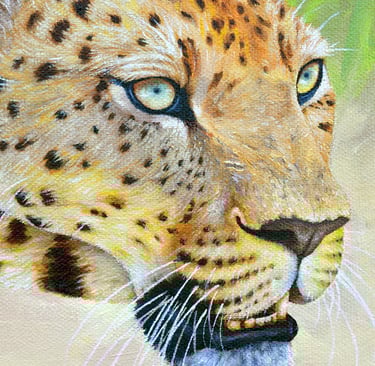
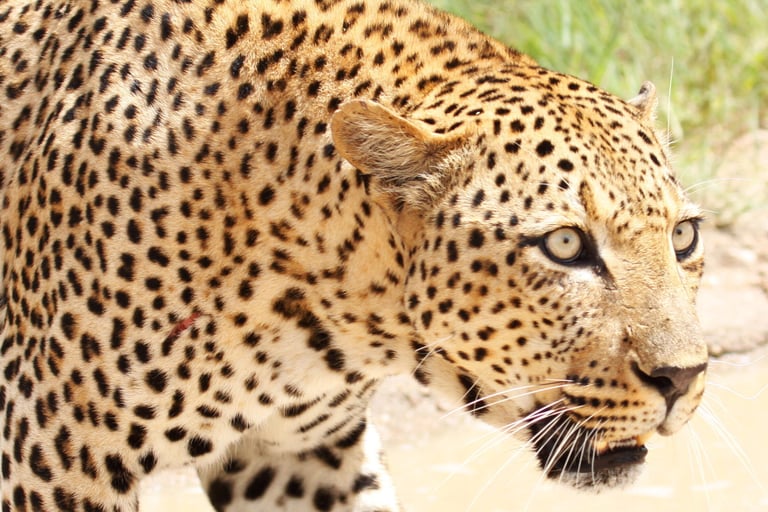
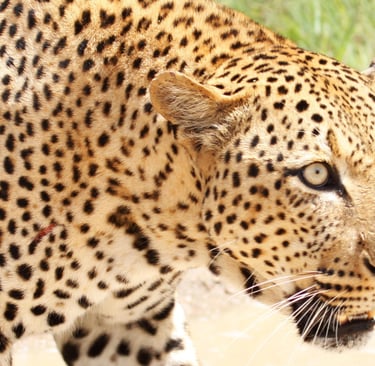
I decided to make just a couple of adjustments for my painting: the canvas I had selected for my first crack was just 12"x10", so I cropped the image a little closer to the face. I also lowered the eyelids slightly to soften the leopard's gaze, whilst keeping their intensity.
You can watch how the painting went on YouTube, but suffice it to say I was really pleasantly surprised by how easy the paints were to work with once I got the hang of them and I loved the results. I've found in the course of this painting that oils make it much easier to achieve a photorealistic finish (mimicking soft focus, overexposure/bloom, etc) than my usual acrylics, which lend themselves well to either structured abstracts (with bold forms and high contrast) or hyperrealism (depicting every minute detail in sharp focus).
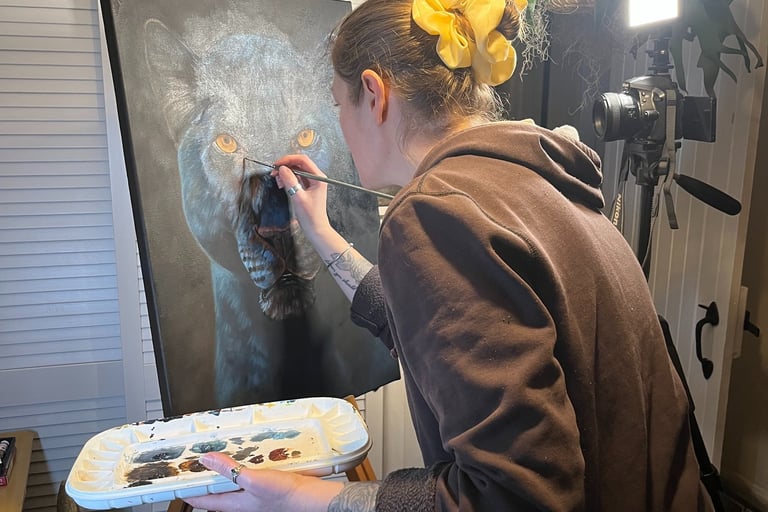
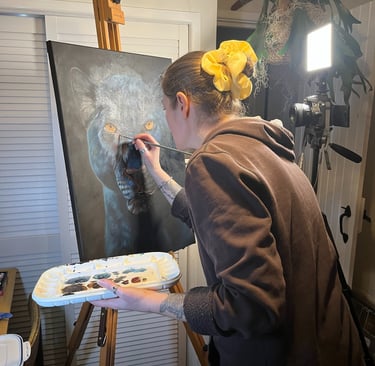
I got straight on to my second oil painting - this time a much more ambitious 20"x28" Amur leopard panther. But suddenly I had a new enemy: dust. I hadn't battled with too much dust settling on my little leopard, and even when a stray strand of lint or cat hair did get lodged in the wet paint, it generally blended in so much as to be unnoticeable. But a black painting was an entirely different matter. Every tiny speck of dust stood out against the silky black of the subject and its background, so I took to taping a sheet of acid-free tissue paper to the top of the painting. This could be lowered to form a light curtain to protect the wet surface between sittings.
Now that the first two cats are finished, I'm working towards completing a whole new collection of big cat oil paintings for release hopefully by the end of this year.
I have to admit, while I love the immediacy and accessibility of acrylic paints, I am enjoying the process of working with oils much more, even with all the added pfaff of mediums, extended drying times and the neverending battle with lint and pet hair (a losing battle in a house with three cats and a dog!) And the soft silky finish suits my style much better I think.
Am I kicking myself that I didn't try oil paints sooner? Well, not really, no, if I'm honest. I don't think regret is a very useful emotion most of the time (sure, it's important to learn from our past and to apologise for our mistakes, but that's not exactly the same thing) There was a certain inertia there on my part down the years and yes, in many ways I do wish I had pursued a fine art career more doggedly when I was younger, but I'm much more concerned with looking to the future now.
The constraints in my past were real: I didn't invent them. I have to remind myself sometimes that I was studying art and graphic design in school in the mid to late nineties and the internet was not the same place is was now. If you wanted a website back then you either had to be a web designer or else hire one at pretty big expense not only to build the thing but then to update it and maintain it. And social media wasn't even a thing so if you wanted to advertise your services, expensive traditional marketing was really the only route available, so there just weren't the same opportunities open to teenage me as there are to forty-something me.
I believe deep down that I'm embarking on this creative adventure now because it's right for me now, and I can't wait to see where it leads...
I did find the drying time a bit of a barrier. Some of the artists and books I have been referencing say an oil painting should be touch-dry in a matter of days, with others advising 3 months or more before applying even a retouch varnish. In the end, I opted to leave my leopard painting on the desk easel, propped right up against the wall while I embarked on my next oil painting, which needed my standing easel anyway, so my leopard wouldn't be in the way. This gave the leopard several weeks to dry completely and being propped up with its face to the wall (with a gap of only about an inch) minimised dust settling on the canvas.